Essential ASTM Standards for
Commercial Granite Paver Specifications
Granite pavers are a proven choice for high-traffic commercial projects, delivering durability, design flexibility, and long-term performance. To ensure that pavers meet the demands of public plazas, streetscapes, and other high-use environments, specifiers rely on ASTM standards—industry benchmarks that measure and confirm a stone’s suitability for different applications.
This guide explores three critical ASTM tests for granite pavers—C97, C99, and C170—and explains how specifiers can interpret results when writing accurate 3-part specifications.
Why ASTM Standards Matter in Commercial Paver Specification
Why ASTM Standards Matter in Commercial Paver Specification
ASTM (American Society for Testing and Materials) standards provide a common language for evaluating stone performance while protecting end users from product failures. For commercial paving, where materials must withstand constant pedestrian traffic, environmental stress, and in some cases vehicular loads, ASTM testing ensures that specified materials are fit for the purpose.
These standards deliver four key benefits to commercial projects:
- Consistency across the industry – All suppliers and specifiers work from the same performance benchmarks
- Protection from product failures – Objective testing data prevents costly material failures in the field
- Prevention of inappropriate applications – Test results guide proper material selection for specific use conditions
- Identification of inadequately tested materials – Specifiers can request testing from quarries and suppliers when data is missing
Not all granite is created the same, and not all granite possesses the same ASTM numbers. Granite is in a broad category of igneous stone that encompasses many variables. It can have a coarse or fine grain, it can have different mixes and percentages of minerals, or even features throughout the matrix that impact the stone’s performance and data points. This is why factual testing data is so crucial to a project’s success when specifying natural stone.
Granite’s reputation as one of the most durable natural stones is backed by ASTM data. Understanding these results allows architects, contractors, and project managers to compare stones objectively when evaluating suppliers, verify compliance with commercial paving requirements, anticipate performance in real-world conditions, and write accurate 3-part specifications that reduce the risk of substitution with underperforming materials.









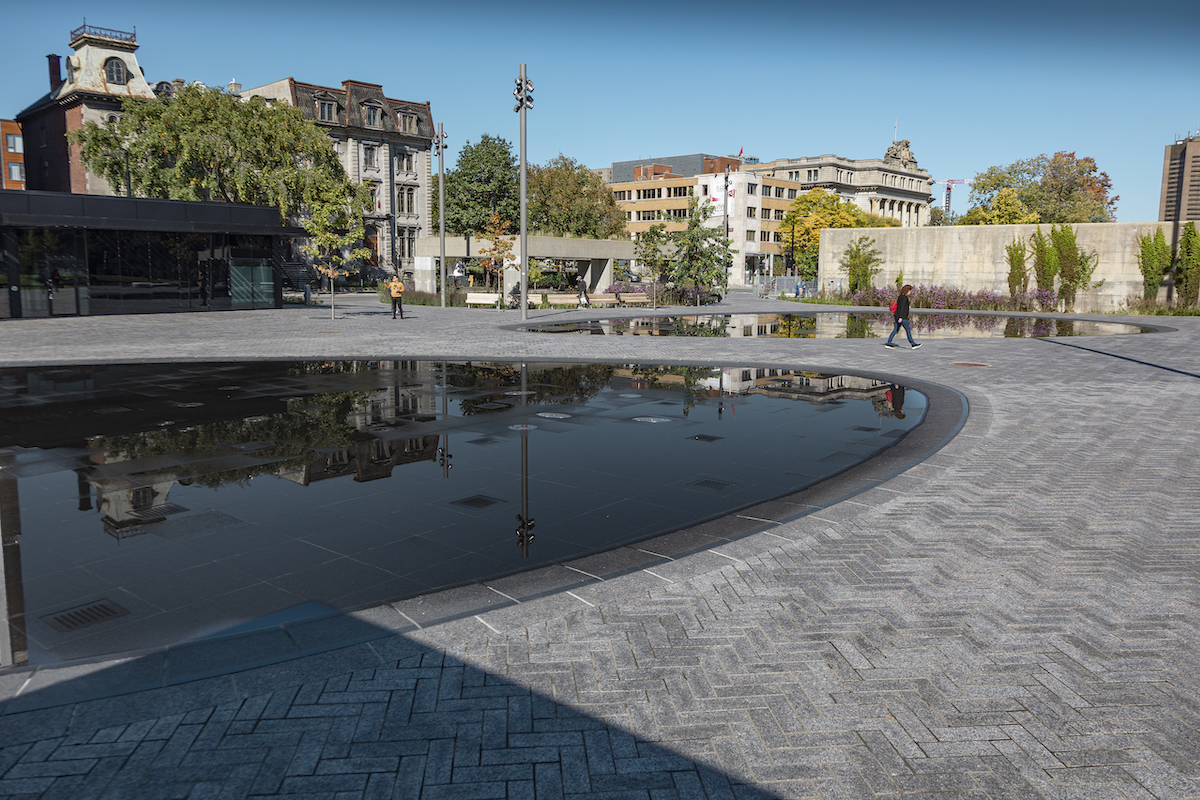
ASTM C97: Absorption and Bulk Specific Gravity
What It Measures
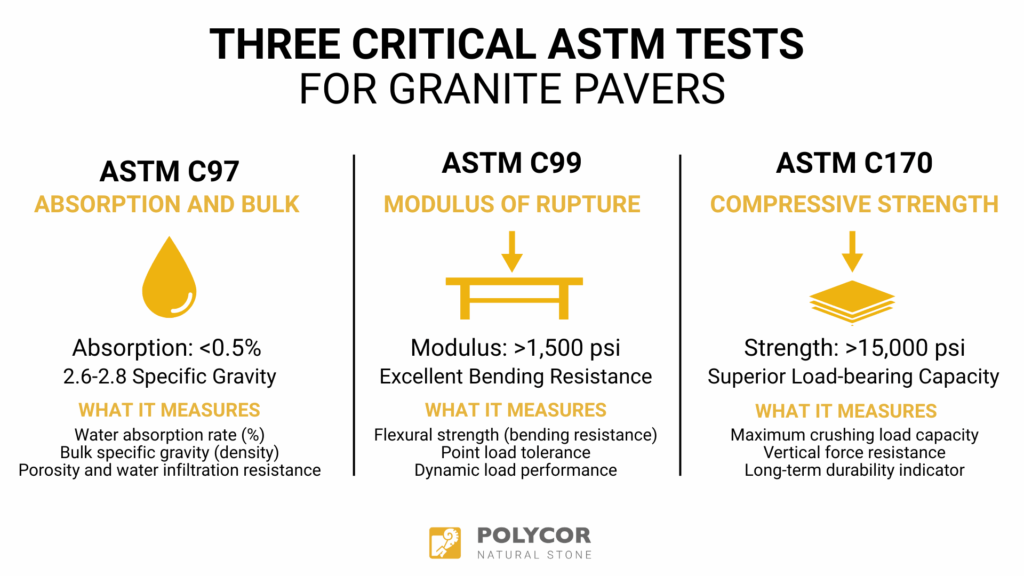
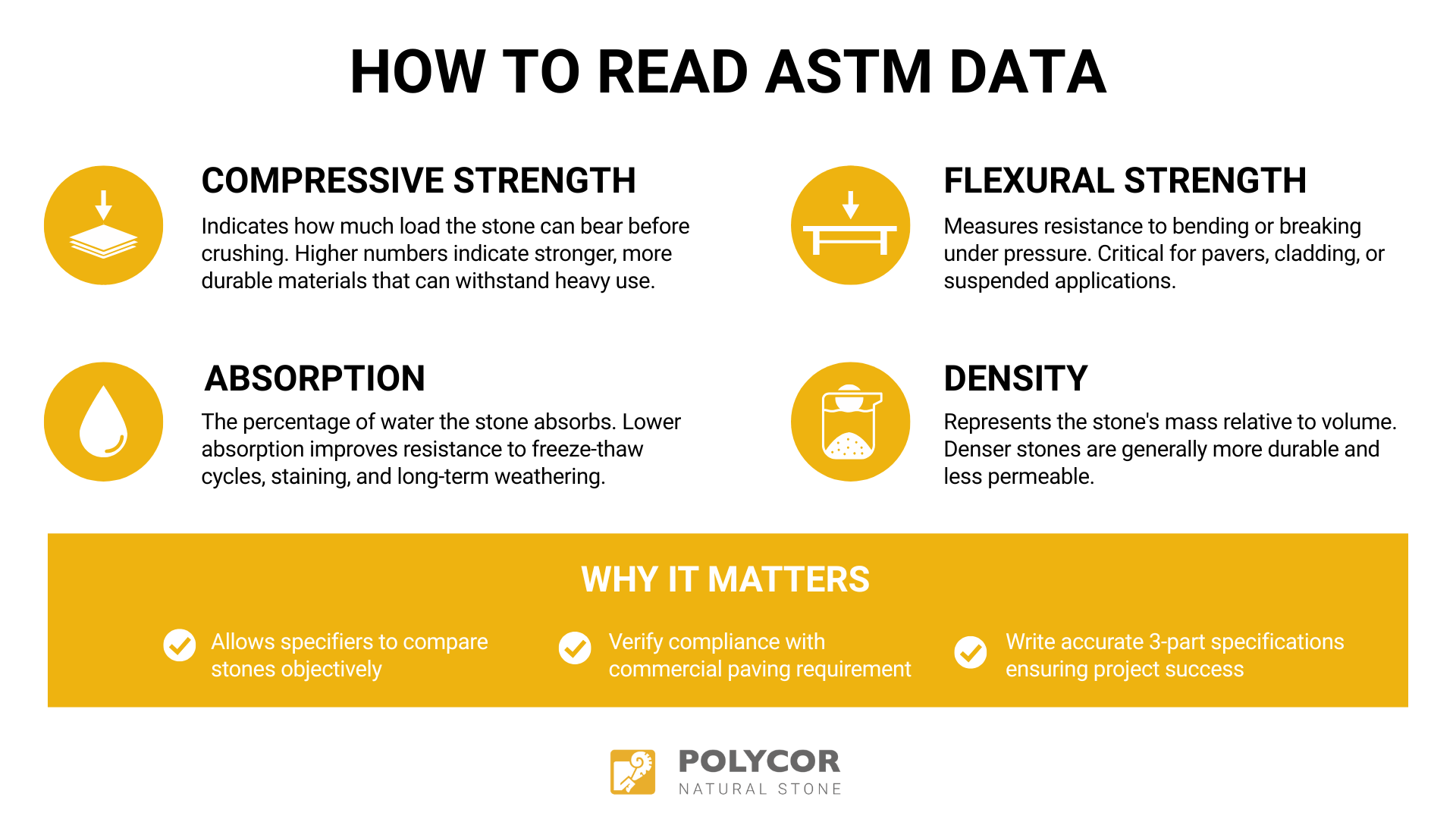
ASTM C97 addresses two fundamental questions about granite pavers: How heavy is it? How porous is it?
This test determines a stone’s absorption rate (the percentage of water it takes in) and bulk specific gravity (density). Absorption indicates how porous the stone is—lower absorption values mean the stone resists water infiltration, reducing risks of freeze-thaw damage, spalling, staining, and weathering. Specific gravity reflects density, and higher density typically correlates with strength and durability.
Typical Granite Results and Performance Thresholds
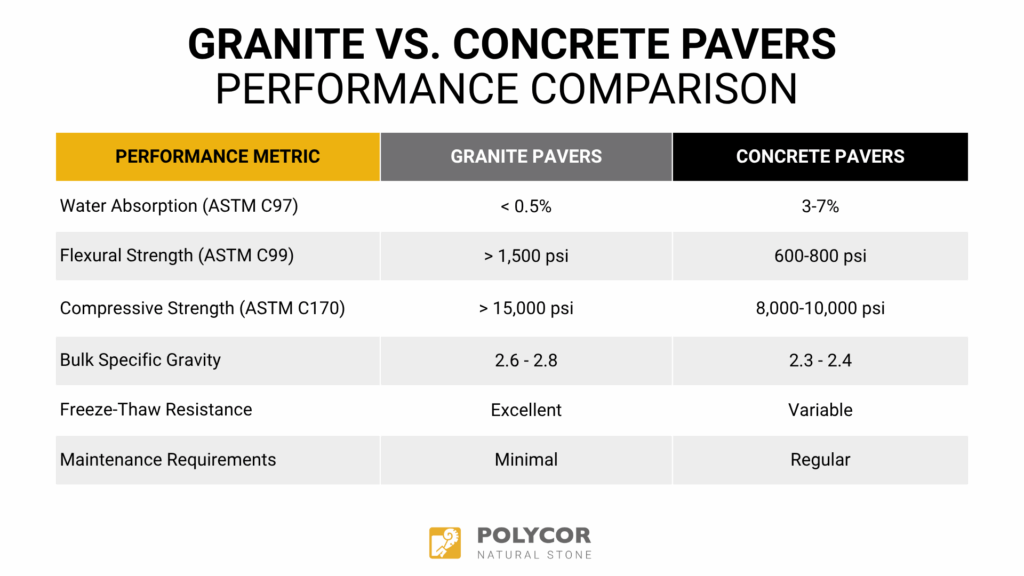
Quality granite pavers often test with absorption rates under 0.5% and high specific gravity values ranging from 2.6 to 2.8, making them ideal for outdoor commercial use. For commercial granite paver specifications, absorption rates should not exceed 0.5% to ensure long-term performance in challenging environments.
Practical Applications in Commercial Projects
Streetscapes and Public Plazas: Low absorption prevents water from penetrating and expanding during freeze-thaw cycles, reducing cracking and spalling that creates safety hazards and ongoing maintenance issues.
Transit Hubs and Building Entryways: Dense granite withstands high foot traffic and exposure to de-icing salts without deterioration, maintaining both appearance and slip resistance over time.
Fountains and Water Features: Resistance to water penetration ensures long-term performance even in constantly wet environments where other materials might fail.
The absorption data from ASTM C97 becomes critical when specifying granite pavers for harsh climates. In northern regions with frequent freeze-thaw cycles, granite’s low absorption rate provides insurance against premature failure—a consideration that impacts both safety and life-cycle costs.
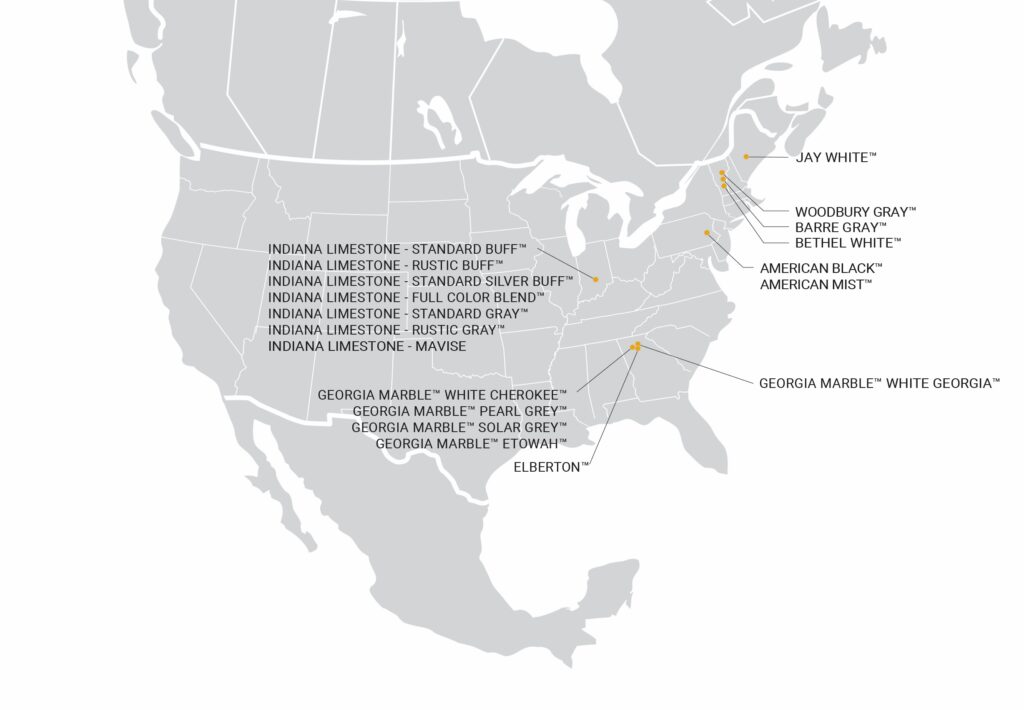
Polycor’s American Quarry Network
ASTM C99: Modulus of Rupture
What It Measures
ASTM C99 evaluates the modulus of rupture by asking: How much pressure can the stone take at one point before it breaks?
This test measures flexural strength—essentially how much bending force a stone can resist before breaking. The test applies a point load to a stone specimen until failure occurs, providing a measurement in pounds per square inch (psi).
Why Flexural Strength Matters
Flexural strength is critical for stone units, including pavers, which experience dynamic loads as people and vehicles move across them. Unlike compressive strength, which measures crushing force, flexural strength evaluates a material’s resistance to bending stress—a common failure mode for paving materials subjected to point loads and uneven support conditions.
Strong flexural capacity ensures granite pavers resist cracking under bending stress, maintaining structural integrity even when installation conditions are less than perfect.
Typical Granite Results
Granite consistently demonstrates higher flexural strength than other commercial materials like concrete pavers or softer natural stones. Quality granite pavers typically achieve modulus of rupture values exceeding 1,500 psi, providing substantial safety margins for commercial applications.
Practical Applications
Pedestrian Paving Systems: High flexural strength ensures granite pavers maintain integrity under constant foot traffic, even when settlement may occur in the base system.
Vehicular Applications: Streetscapes designed for occasional vehicle use—service lanes, emergency access, or shared spaces—benefit from granite’s ability to resist flexural stress in a properly designed system.
Suspended Paver and Pedestal Systems: In roof decks or raised terrace designs and pedestal systems, modulus of rupture data confirms safe performance under concentrated loads where unsupported paver spans need to be determined.
For specifiers, ASTM C99 data provides confidence that granite pavers will perform reliably even under challenging loading conditions that might otherwise cause materials to fail.
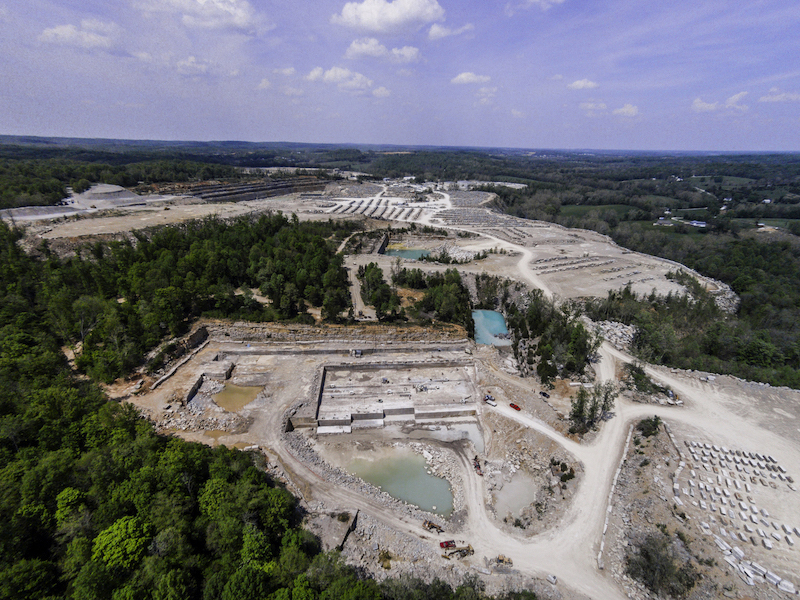
ASTM C170: Compressive Strength
What It Measures
ASTM C170 measures compressive strength by determining: How much can I squash it before it breaks?
This test evaluates the maximum load a stone can bear before crushing, applying increasing vertical force until the specimen fails. Results are reported in pounds per square inch (psi).
Why Compressive Strength Matters
In commercial paving, compressive strength serves as the ultimate indicator of long-term durability. It reflects a stone’s capacity to carry heavy loads without deforming or breaking—essential for applications ranging from pedestrian plazas to areas with the occasional vehicle access.
Unlike other building materials that may show gradual degradation under load, natural stone typically maintains consistent performance until reaching ultimate failure—making compressive strength data highly reliable for long-term predictions.
Typical Granite Results
Granite pavers often exceed 15,000 psi in compressive strength, far surpassing minimum thresholds for commercial paving applications. This performance level places granite among the strongest paving materials available, providing significant safety margins and longevity for even the most demanding commercial projects.
To put this in perspective, concrete pavers typically range from 8,000-10,000 psi in compressive strength—less than half of typical granite performance.
Practical Applications
Public Plazas and Gathering Spaces: High compressive strength allows granite pavers to withstand large crowds and heavy use without deformation, rutting or the exposed aggregate found in precast concrete and interlocking concrete paving.
Urban Streetscapes: The ability to support service vehicles and occasional traffic in shared spaces makes granite suitable for mixed-use environments where loading conditions can vary dramatically.High-Load Commercial Zones: Entry drives, delivery areas, and civic spaces where compressive loads are significant benefit from granite’s exceptional load-bearing capacity, specifically where permeable bonded trass mortar systems are utilized.
Using ASTM Data in 3-Part Specifications
When developing 3-part specifications for granite pavers, ASTM C97, C99, and C170 provide the technical backbone of Part 2: Products. These values establish minimum performance criteria that bidders must meet, prevent substitution with materials of lesser durability, provide measurable assurances for project stakeholders, and support sustainable, long-term outcomes by ensuring materials can handle decades of use.
Example Specification Language
Section 2.1 – Performance Requirements:
- Granite pavers shall have maximum water absorption of 0.5% per ASTM C97
- Granite pavers shall have minimum modulus of rupture of 1,500 psi per ASTM C99
- Granite pavers shall have minimum compressive strength of 17,000 psi per ASTM C170
Section 2.2 – Testing and Documentation:
- Supplier shall provide certified ASTM test reports from an approved testing laboratory
- Test results shall be based on minimum five specimens per test
- Test reports shall be dated within 24 months of project bid date
By incorporating these benchmarks, specifiers create enforceable quality standards while streamlining the procurement process and reducing the risk of material substitution.
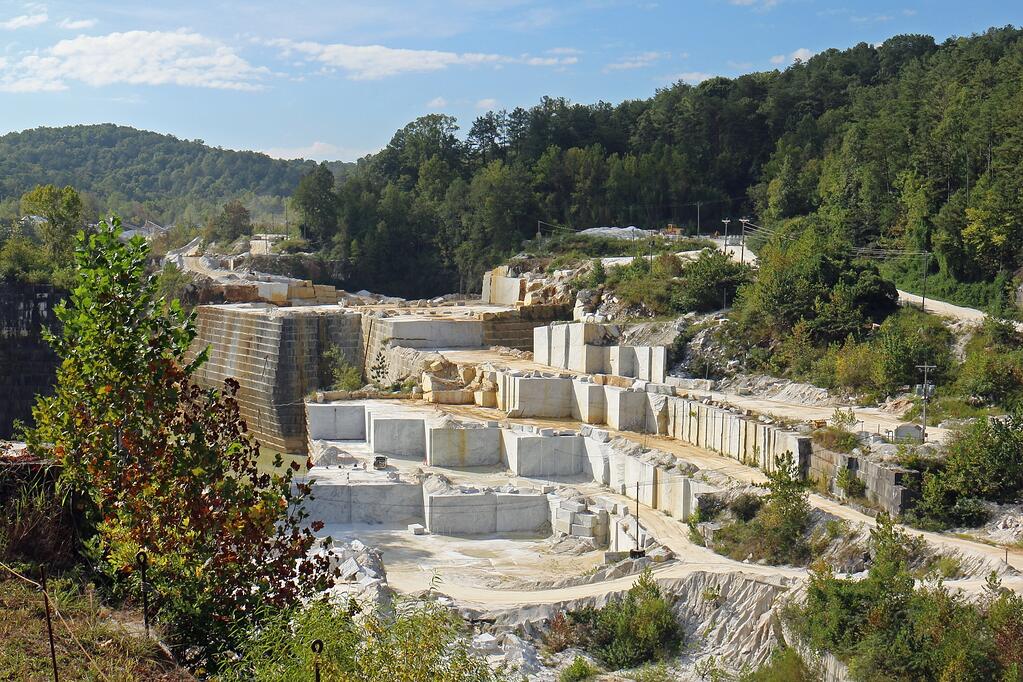
Providing additional details related to specific quarry sources, quarry locations with addresses, and quarry company or manufacturer names will further strengthen the spec. This becomes increasingly important as project timelines may change and verifiable stone sources are required for accountability and to meet the demands of the project.
Why Granite Pavers Outperform Alternatives
Concrete and other manufactured pavers often fall short in ASTM testing compared to granite. While they may meet minimum compressive requirements initially, their absorption rates and long-term performance in freeze-thaw cycles are typically less reliable which can lead to shorter lifecycles, future replacement, and additional costs. Granite’s natural density, low absorption, and high strength ensure it performs for decades with minimal maintenance—an essential consideration in life-cycle cost analysis.
The combination of low absorption (ASTM C97), high flexural strength (ASTM C99), and exceptional compressive strength (ASTM C170) creates a performance profile that manufactured alternatives struggle to match, particularly when long-term durability and minimal maintenance are project priorities.
The Value of Early Collaboration
ASTM standards provide measurable benchmarks, but collaboration with quarry owners and natural stone suppliers, like Polycor, ensures results are interpreted in the context of specific project conditions. Factors like paver sizes, aspect ratios, thickness, surface finish, installation method, climate, and intended application should all be discussed early in the specification process.
By engaging suppliers early, specifiers not only gain access to certified ASTM test reports for specific granite varieties, but can also better value-engineer their projects. By understanding factors such as yield from the quarry blocks, the stone color and pattern range, as well as the range within the quarry, specifiers gain a competitive advantage while building strong relationships based on trust and accountability.
When suppliers at the dealer or distributor level cannot provide current ASTM data for stones, specifiers should request testing from the quarry directly—a reasonable requirement that ensures materials meet project performance standards.




Conclusion
ASTM C97, C99, and C170 form the foundation of performance-based specification for granite pavers in commercial projects. By understanding absorption, flexural strength, and compressive strength, architects and specifiers can confidently select materials that meet the demands as defined in their projects master specs.
When written into 3-part specifications, these standards provide objective assurance of performance, reduce substitution risk, and contribute to long-lasting, sustainable designs. Granite’s ability to consistently exceed ASTM thresholds makes it one of the most reliable choices for commercial paving—backing up its reputation not only with beauty, but also with proven technical performance that protects both end users and project stakeholders.