The Art of Specifying Natural Stone: A Practical
Guide for Architects and Design Professionals
Natural stone is one of the most enduring building materials on the planet. From Roman aqueducts to modern civic plazas, it has proven its worth across centuries of use. But specifying natural stone, particularly for commercial paver and cladding applications, requires more than a good eye for aesthetics. It demands a working knowledge of material science, supply chain realities, installation methods, and long-term performance expectations.
This guide walks through the key principles of natural stone specification. It covers how to evaluate a material’s admirable qualities, confirm its suitability, verify availability, and manage affordability — all while understanding the responsibilities each stakeholder carries throughout the project.
Understanding Who’s Responsible for What
Before diving into material selection, it helps to understand how responsibilities are distributed across a typical commercial construction project. There are four key groups involved: the design professional (architect or designer), the general contractor, the material supplier, and the building owner.
The architect’s primary job is to select a material that meets both aesthetic and performance criteria, and to write a specification thorough enough that every downstream party can bid accurately and install correctly. That means referencing the right ASTM test standards, defining acceptable material ranges, and calling out appropriate installation methods.
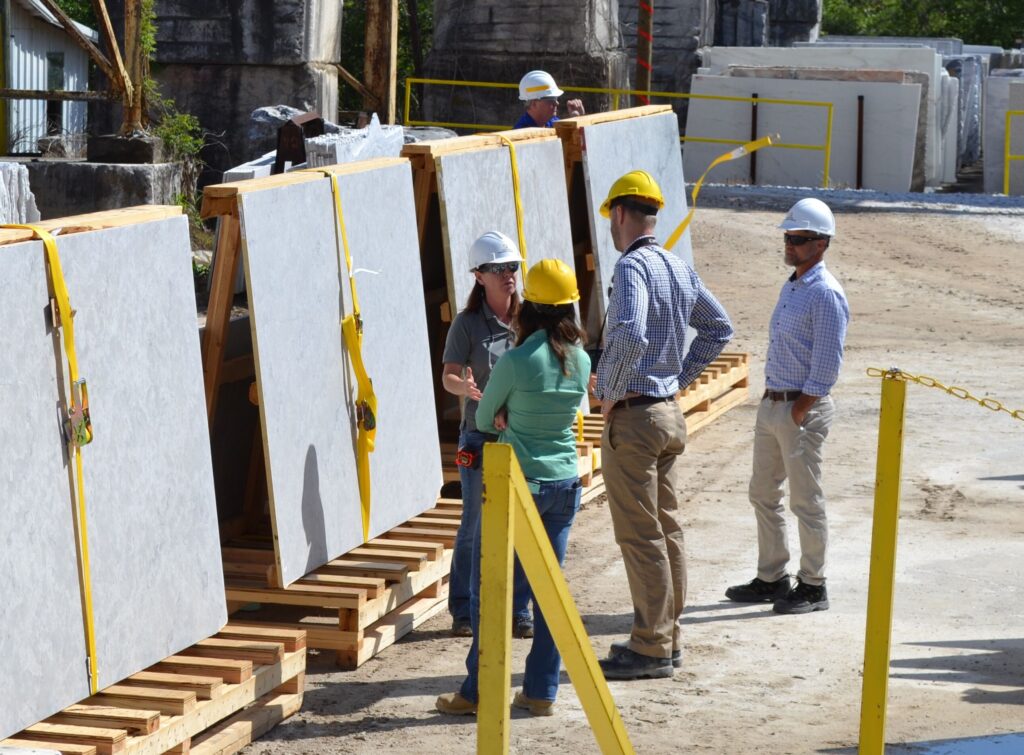
The material supplier’s role is to source stone that meets or exceeds the specification’s parameters, provide required samples, and deliver any testing documentation needed to substantiate the material. For most standard tests, a reputable quarrier (like Polycor) will already have this data on file.
The contractor provides the skilled labor and must adhere strictly to the prescribed installation methods and materials. And the building owner? They need to provide realistic performance expectations from the start and commit to a maintenance program that protects the investment over the long term. Bringing all of these parties into alignment early in the design process is what separates a smooth stone project from a costly one.
Start With the Right Resources
Architects and designers don’t have to figure this out alone. There are well-established resources that take much of the guesswork out of specifying natural stone, whether it be granite, marble, limestone or schist.
ASTM International publishes the testing standards that define how stone performance is measured. Key tests include:
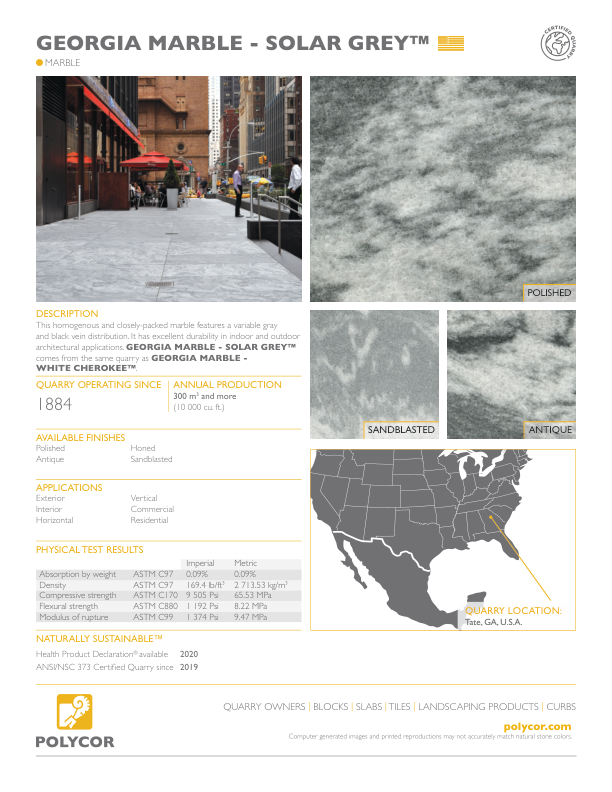
- C-97 (Absorption and Density) — Helps assess stain resistance and suitability for freeze-thaw environments. This is especially critical in climates like Denver, for example, which sees over 100 freeze-thaw cycles annually.
- C-170 (Compressive Strength) — Essential for load-bearing applications like stacked stone walls or heavy vehicular paving exposed to fire trucks and garbage trucks.
- C-880 (Flexural Strength) — The preferred method for evaluating stone used in cladding applications, simulating how a panel anchored at the top and bottom will resist wind loads.
- C-241 (Abrasive Hardness) — Determines scratch resistance, which is a make-or-break factor for high-traffic flooring applications.
- DCOF (Dynamic Coefficient of Friction) — Measures slip resistance, a liability-critical metric for any horizontal surface with pedestrian traffic.
The Natural Stone Institute (NSI) publishes the Dimension Stone Design Manual, which includes an index of ASTM minimum requirements by stone type which is an invaluable reference when evaluating whether a material is appropriate for a given application. NSI also maintains a directory of accredited installers and fabricators, vetted for expertise, quality control, and business practices. Using NSI-accredited partners adds a meaningful layer of accountability to any project.
Is It Admirable? Aesthetic Selection Done Right
Once the performance framework is in place, the design work begins. The goal here is to select a material that is genuinely admirable. It needs to check the boxes as something the client, the community, and the design team can be proud of for decades.
Work from current samples. Every architecture firm has a sample library, but materials evolve over time. A granite sample sitting on a shelf from eight years ago may no longer reflect what’s coming out of the quarry today — or the quarry may no longer be active at all. The most reliable approach is to partner early with a knowledgeable quarrier or supplier who can provide current samples and production photos representing what is actually being extracted today.
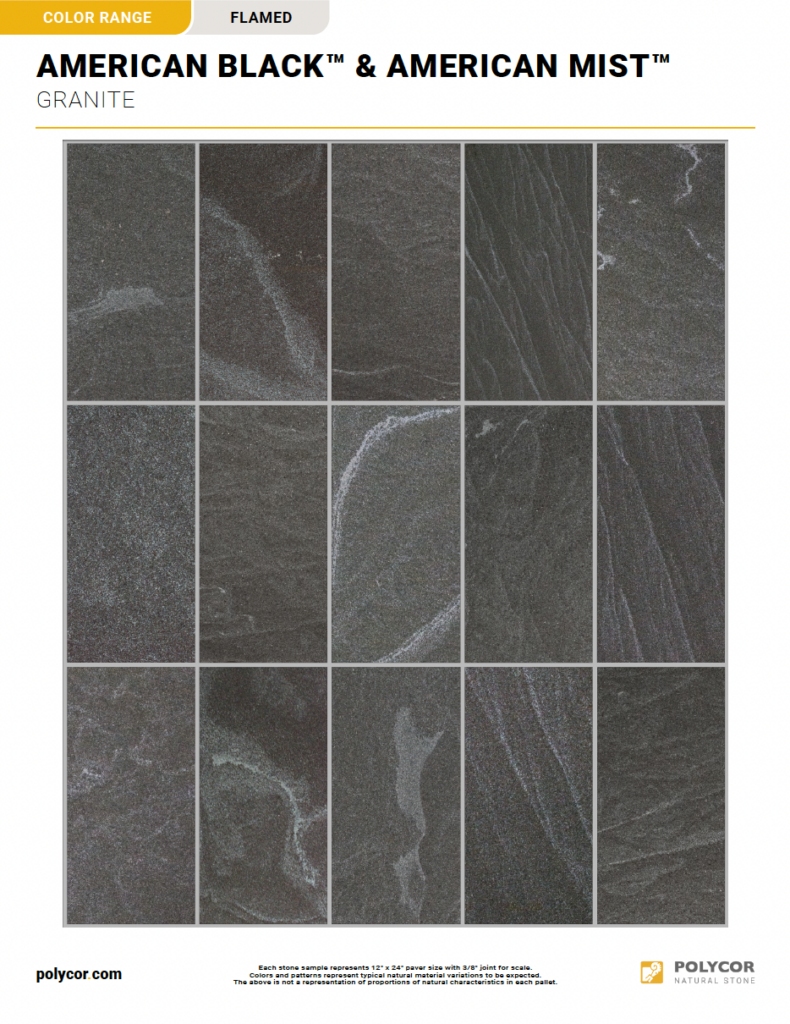
Define an acceptable range. No two pieces of natural stone are identical. Color variation, veining, quartz inclusions, fossils, pits, fissures, and tonal shifts are all part of what makes stone beautiful — and they’re inherent to the material. Architects should establish a realistic stone range of acceptable variation early in the process. Trying to control it too tightly drives up waste, extends lead times, and significantly increases cost. The quarrier has to cut through more material to meet a very narrow range, and that expense flows downstream to the project.
For larger commercial projects, consider scheduling a range review at the quarry or fabrication facility. Viewing actual slabs or a full-scale mock-up of a paving or cladding detail is far more informative than evaluating a 4×4 sample. It’s an additional coordination cost, but for a large urban plaza or institutional building, it’s a small investment compared to the cost of course-correcting mid-production. Plus, it allows an opportunity to build relationships with the stone suppliers and vet their credentials.
Plan for longevity. Is this a 50-year building or a 100-year building? A transit hub or a boutique hotel lobby? The intended lifespan and use intensity of the space should directly inform material selection. Stone that performs beautifully in a low-traffic hospitality environment may not hold up in a busy transit concourse. Factor in finish durability, maintenance requirements, and sealer compatibility from the outset.
Is It Suitable? Matching Stone to Application
Not all stone is created equal — and not all stone is created for the same purpose. Understanding the basic geology of natural stone helps architects and designers make informed decisions.
Stone falls into two broad mineralogical categories: calcareous (calcium-based, like limestone and marble) and siliceous (silica-based, like granite and quartzite). Within these groups, stones are further classified as igneous, metamorphic, or sedimentary — each with different density, porosity, and durability profiles.
For exterior paving applications, several suitability questions demand answers:
- How many freeze-thaw cycles will the stone be exposed to each year, and is its porosity low enough to handle them?
- Will de-icing salts chemically interact with the material over time?
- How will atmospheric pollutants — sulfur dioxide, acid rain, carbon deposits — affect the surface and subsurface?
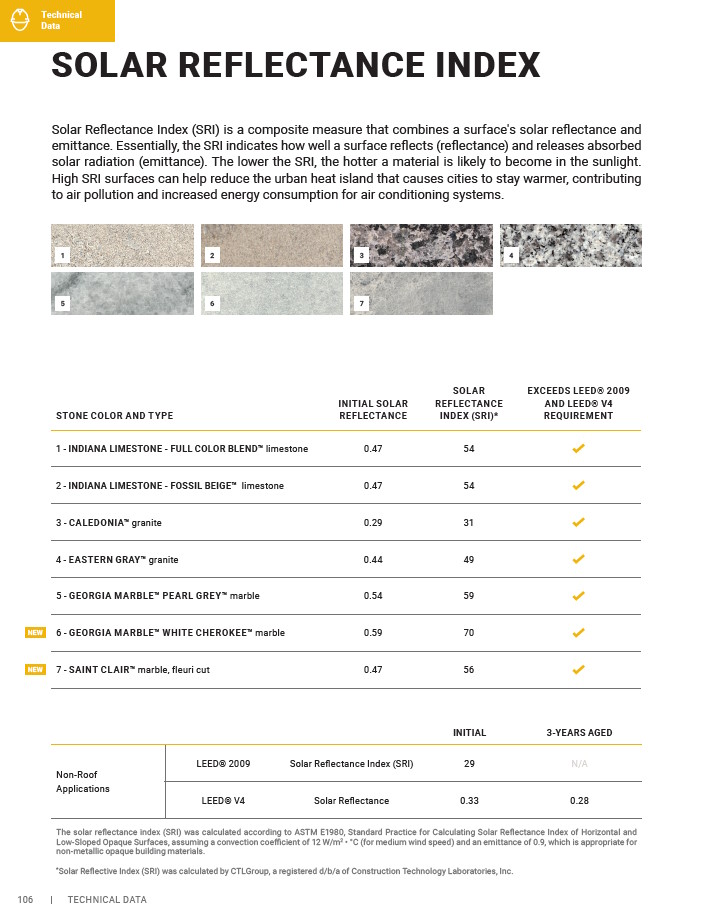
- What is the stone’s Solar Reflectance Index (SRI)? Light-colored limestones and white granites reflect more solar energy and stay cooler underfoot, which is an important consideration for public plazas and urban heat island mitigation.
For flooring applications, abrasive hardness minimums are a practical guide:
- Residential entryways: minimum 6.0
- Moderate commercial traffic: minimum 7.0
- Heavy commercial (airports, malls): minimum 10.0
- High-concentration areas (lobbies, elevator landings, stairs): minimum 12.0
- Exterior paving: minimum 12.0
Specifying a marble with an abrasive hardness of 6.0 for a busy shopping mall floor isn’t a design choice — it’s a liability. The material will show wear and scratching within weeks of opening.
Finish selection also factors into suitability. Vertical applications like wall cladding offer wide latitude — from polished to split-face, almost any finish is appropriate. Horizontal paving is more constrained. For exterior pedestrian surfaces, textured finishes like thermal (flamed), sandblasted, or bush-hammered surfaces are specified to maximize slip resistance without creating a tripping hazard. There’s a balance to strike, and getting physical samples in the actual finish early in the design process is always best practice.
Suitable substrate design, proper expansion and control joints, and adequate drainage are equally important. Architects may not love the visual interruption of control joints in a paving pattern, but omitting them is a reliable path to cracking and costly repairs down the road.
Is It Available? Vetting the Supply Chain
Specifying a beautiful stone that can’t actually be delivered on schedule — or at all — is one of the more painful lessons in commercial stone work. Availability is not just a logistical question; it’s a risk management question.
Verify quarry access and production capacity. Some quarries shut down seasonally due to weather. Others have limited block reserves. A few have been subject to government restrictions or forced closures — the Indian Kashmir quarries and restrictions on Chinese Luna Pearl production are real examples that caught specifiers off guard. Understanding the stability and scale of a quarry’s operations protects the specification from sudden substitution requests later in the project.
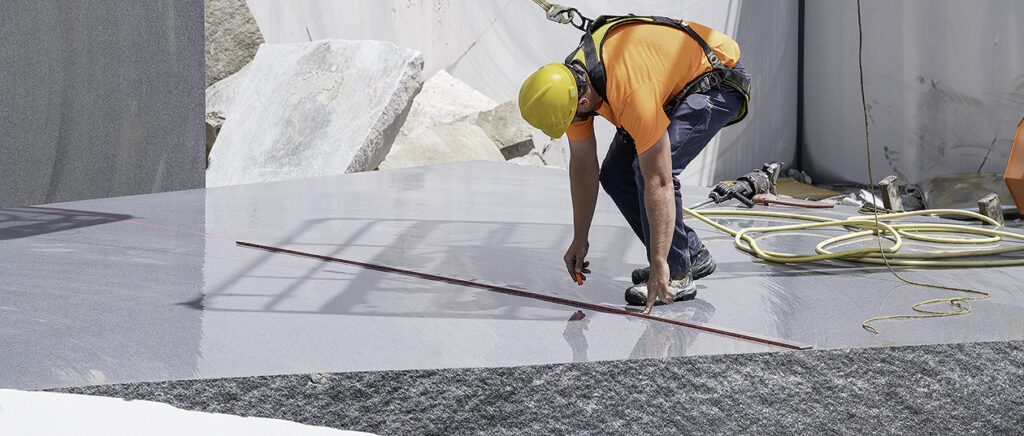
Understand what the fabricator actually specializes in. A supplier primarily set up for large-format countertop slabs may not have the equipment or expertise to efficiently produce thick commercial pavers, dimensional curbing, or cut-to-size cladding panels. Ask directly: Can they sequence production to match phased site delivery? Can they produce cubic work like copings and cornices? Do they have the finishing capabilities required?
Check market demand. High-trend materials — certain marbles, for example — can be consumed rapidly by competing projects or large government contracts. If a client falls in love with a stone that’s in high demand, it’s worth locking in material commitments early or at minimum getting a written commitment from the supplier regarding availability during the project’s critical path.
Watch for third-party sourcing. An increasing number of fabricators are processing blocks sourced from countries other than where they’re based, and not always transparently. If a supplier is presenting a material as one they have strong control over, it’s fair to ask: Where does the block originate? Who controls that quarry? What happens if that supply is disrupted?
Is It Affordable? Value Engineering from Day One
One of the most avoidable project outcomes is losing a natural stone specification to precast concrete or synthetic alternatives because cost wasn’t managed from the start. The time to do value engineering on a stone project is at the beginning — not after design development is complete. Estimating the total lifecycle in material comparisons is tantamount to executing a tight spec, such as the lifecycle cost comparison of natural stone vs concrete pavers.
Several factors drive the final cost of natural stone:
Quarry yield and efficiency. A quarry with high waste rates — due to difficult geology, excessive veining, or outdated extraction technology — passes those costs downstream. Asking about expected yield percentages is a fair question for any supplier.
Transportation and logistics. Is the quarry close to the processing facility? How far is the fabrication plant from the port? Is there a complex inland transport route? Every leg of the journey adds cost, and some materials that seem competitively priced initially carry significant hidden freight exposure.

Tariffs and geopolitical exposure. Stone sourced from overseas carries tariff risk. Materials cut and shipped from politically sensitive regions may face supply chain disruption or price volatility that domestic or North American-quarried stone simply does not.
Thickness and format. If a project can achieve the required structural performance with 2 cm thickness rather than 3 cm, that’s a direct material and freight savings — provided the spec homework has been done. Similarly, smaller paver formats like 12×12 generate less waste than large-format cuts, which can meaningfully reduce cost per square foot.
Finish complexity. Certain finishes are more labor-intensive to produce. Mosaics, highly customized patterns, and unique surface treatments come at a premium. If budget is a constraint, it’s worth understanding the cost differential between finish options early — before design intent is locked.
Demand and market timing. Basic economics apply: materials in high demand cost more. Selecting a stone that isn’t at peak trend can deliver meaningful savings without compromising the design.
The Bottom Line on Natural Stone Specification
Specifying natural stone for commercial paver or architectural applications is as much a discipline as it is an art. The most successful projects share a few common traits: early engagement with knowledgeable quarry partners, rigorous application of ASTM performance standards, a realistic approach to material range and availability, and a cost management mindset that starts at the design table — not the value engineering table.
Polycor’s team of stone specialists works directly with architects, designers, and specifying professionals throughout this process — from initial material selection and sampling through testing documentation, fabrication, and project delivery. With quarrying and processing operations spanning Indiana limestone, Georgia marble, and Vermont granite, Polycor brings both the depth of material knowledge and the supply chain reliability that complex commercial projects demand.
When the specification is done right, natural stone doesn’t just perform — it endures.
For project specifications, material samples, or ASTM test data on Polycor’s stone products, contact the Polycor architectural team or visit polycor.com.