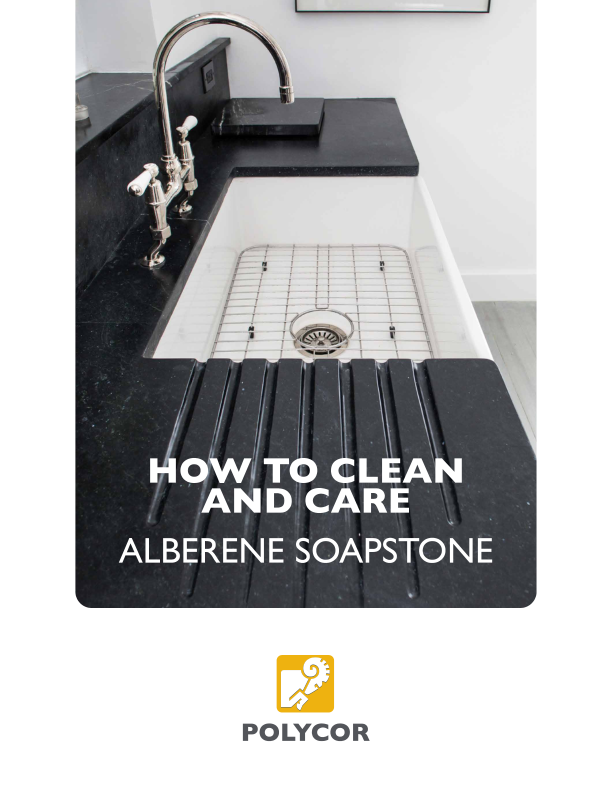
ALBERENE SOAPSTONE™ – Care & Maintenance
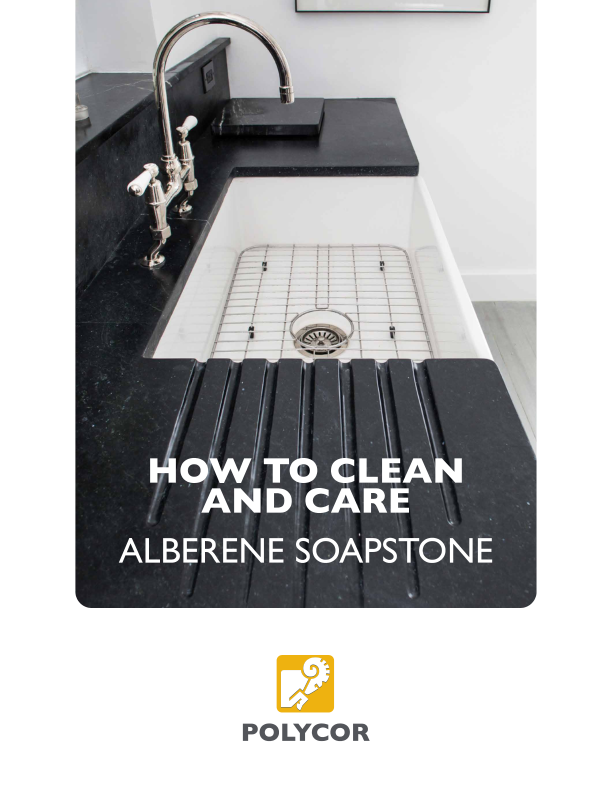
How to Clean, Darken, and Care for Alberene Soapstone
Soapstone has natural characteristics that make care and maintenance easy. Unlike granite and marble, it does not require sealing, and scratches do not require professional attention.
Soapstone Is:
- Heat resistant. You can take a pan right from the stove to the countertop.
- Non-porous. Soapstone is bacteria resistant because it does not absorb food or liquid; any residue sits on top of the stone and cleans away with simple soap and water. Unlike granite and marble, it does not need to be sealed with chemical agents, and we recommend that it not be sealed.
- Free of professional repairs. Unlike granite and marble, scratches do not require professional attention.
- Acid resistant. You can spill almost anything on soapstone and it will be fine; it’s required in many laboratories and acid rooms.
- Easy to color. If you want to keep the stone’s natural coloring, no treatment is required, just soap and water. If you want to darken it, you treat it annually yourself, using a natural wax or oil rather than a chemical-based product.
Cleaning
Simple soap and water. Nothing more is required. Any household cleaner will work, but soap and water is the easiest and best way to go.
Darkening and Treating
Some people like to keep the stone’s natural coloring. If that’s the case, nothing needs to be done; the stone will darken slightly with age and patina on its own. If you want to darken it deliberately, there are three basic options: mineral oil, dry wax, and chemical treatment (such as Tenax Tiger Ager).
Dry Wax vs. Mineral Oil
Both products are natural, food safe, and easily obtained. Alberene sells a custom, locally made dry wax; mineral oil is sold in almost any hardware store. Here’s why Polycor recommends dry wax:
- Easier application. Mineral oil needs weekly application for six to seven weeks to get sustainable darkening, then about every three months after that. Dry wax needs weekly application for three weeks, then only every 8 to 12 months for a sustainable, rich color.
- Better look. Mineral oil evaporates unevenly and can leave a splotchy finish, even after multiple applications. Dry wax leaves an even luster, actually a deeper, richer, almost smoother finish.
- Not messy. Mineral oil is oil; touching the bottle often leaves hands greasy, and it will stain paper left on it even a week after application. Dry wax goes on quickly with little residue.
- Hypoallergenic. Both products are all natural and food safe.
Chemical Agents
Two chemical products are easily obtained: Tenax Tiger Ager and Akemi Dark and Super. Neither is a natural product, but both darken the stone in a similar way to mineral oil without needing frequent reapplication, roughly once at the start and then every five years or so. Polycor does not recommend chemical agents for countertops, though they work well for wall tiles, fireplace surrounds, and vanity tops. For countertops, dry wax is recommended because it’s natural, lasts a long time, and produces the dark color most people want. For anyone who wants zero maintenance, Tiger Ager is the alternative.
Repairing Scratches
Repairing soapstone scratches is simple and does not require expensive professional attention. Almost all scratches go away with a small application of dry wax or mineral oil, if you’ve used one of those products on the surface previously. Deeper scratches require some sanding, just like wood.
- Gather three grits of sandpaper or sanding pads, available at almost any hardware store: 80, 120, and 200 grit.
- Start with 80 grit. Lightly rub on and around the scratch until most of it wears away. Be careful not to sand so much that you create a divot or depression.
- Use 120 grit to finish sanding down the affected area.
- Finish with 200 grit to smooth out the area.
- Apply dry wax or mineral oil, whichever you’ve used to treat the stone.
Want a printable, save-for-later copy of this guide? Download the full PDF above.