
Stone Range in Natural Stone Specifications:
What It Means and Why It Affects Your Project Budget
The difference between a $200,000 stone paving budget and a $280,000 one? How much natural variation specifiers are willing to accept. Polycor’s newly released paver range sheets provide architects, landscape architects, and commercial developers with essential tools to balance design aesthetics with project economics while embracing the inherent beauty of natural stone variation.

What is Stone Range in Natural Stone Specifications?
Stone range is the natural variation in color, tone, veining, and surface texture that exists within any given natural stone — and it’s one of the most cost-consequential decisions in a commercial paver specification. The wider the range a specifier accepts, the more efficiently a quarry can produce, and the lower the project cost. Accepting a narrow, tightly controlled range drives up waste, extends lead times, and can add tens of thousands of dollars to a paving budget. Polycor’s paver range sheets give architects, landscape architects, and commercial developers a visual and technical framework for making that decision with clarity before it affects the budget.
Natural stone celebrates variation as one of its defining features. This variation spans from uniform granite materials with minimal color and pattern changes to highly variable marble that showcases dramatic natural differences within the same quarry block. Some materials display highly consistent tones and textures, while others shift dramatically, even within the same slab or paver. At one end of the spectrum, uniform materials deliver a consistent appearance but come at a premium due to the selective quarrying and processing required to work around features in the parent rock. In the middle, controllable materials can be managed through sorting and defining acceptable parameters of variation, allowing specifiers to fine-tune the level of consistency. At the other end, variagated stones showcase broad and dramatic differences, rewarding projects with associated cost savings and unique aesthetic richness.
We like to say that “there’s no such thing as a single control sample in Mother Nature.” This fundamental understanding is crucial for architects and specifiers who want to work effectively with natural stone rather than against its inherent characteristics.
How Does Stone Range Acceptance Affect Commercial Paving Project Costs?
The economics of stone range specification are simple but powerful: in general, the wider the range accepted, the lower the cost. Accepting a broader aesthetic range allows fabricators to use more blocks from inventory, reduce waste from over-sorting and working around features, and improves yield efficiency.
For large commercial projects, these benefits are magnified. Less time is spent chasing perfectly uniform material, production flows more smoothly, and project timelines improve because supply is not held up by selective requirements.
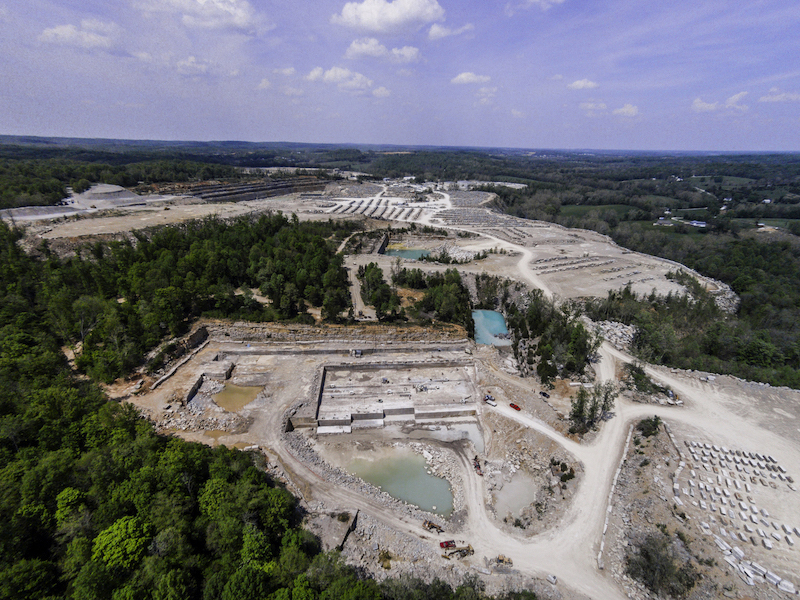
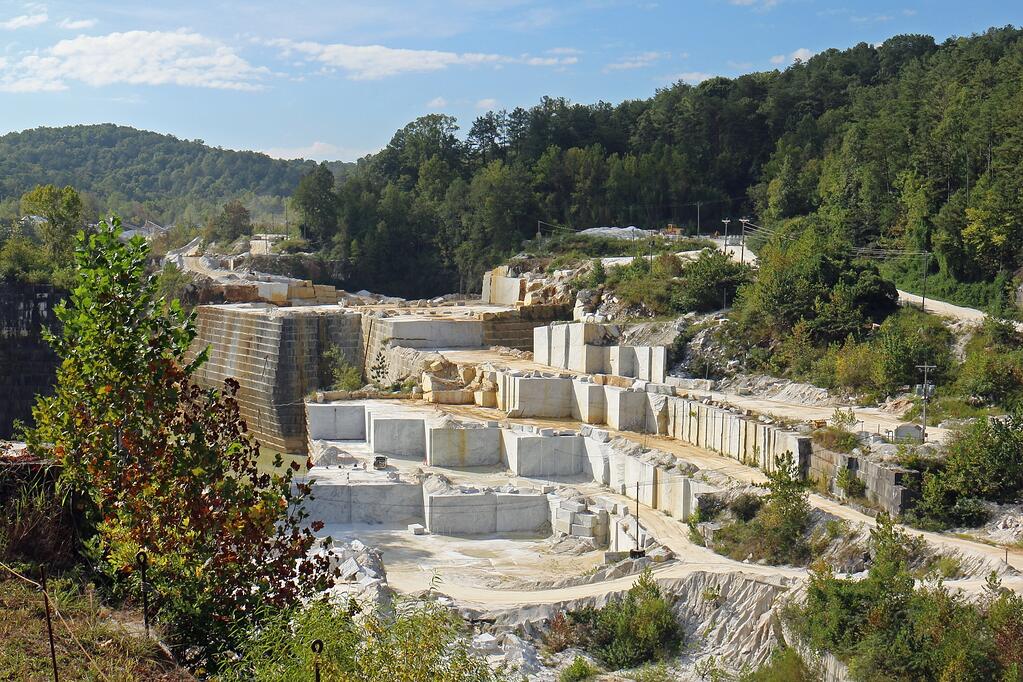
Polycor’s integrated quarry-to-finished-product operations make these dynamics more transparent, allowing for greater control, and providing the opportunity for direct involvement with the stone source, i.e. the quarry owners / operators / manufcturers. By seeing what range actually exists in the mountain and across production, specifiers can align budgets with realistic expectations and avoid cost or timeline shocks mid-project.
Why a Single Stone Sample Can’t Represent Full Material Range
When specifying natural stone, it’s essential to distinguish between promotional samples and range approval samples. Promotional samples showcase a stone’s aesthetic potential, highlighting its background color, veining patterns, and grain structure, but they cannot represent the full spectrum of variation that exists within a quarry block or across multiple blocks.
A single sample extracted from one area of a slab may appear uniform in color and texture, creating an expectation that the entire project will match that exact appearance. However, different sections of the same slab can vary significantly in tone, veining density, and pattern. This is why there’s no such thing as a “single” control sample in Mother Nature. Working directly with the quarry source to define the parameters provides the most accurate representation of what the stone actually looks like in production, and when it is installed, rather than relying on a random promotional piece.
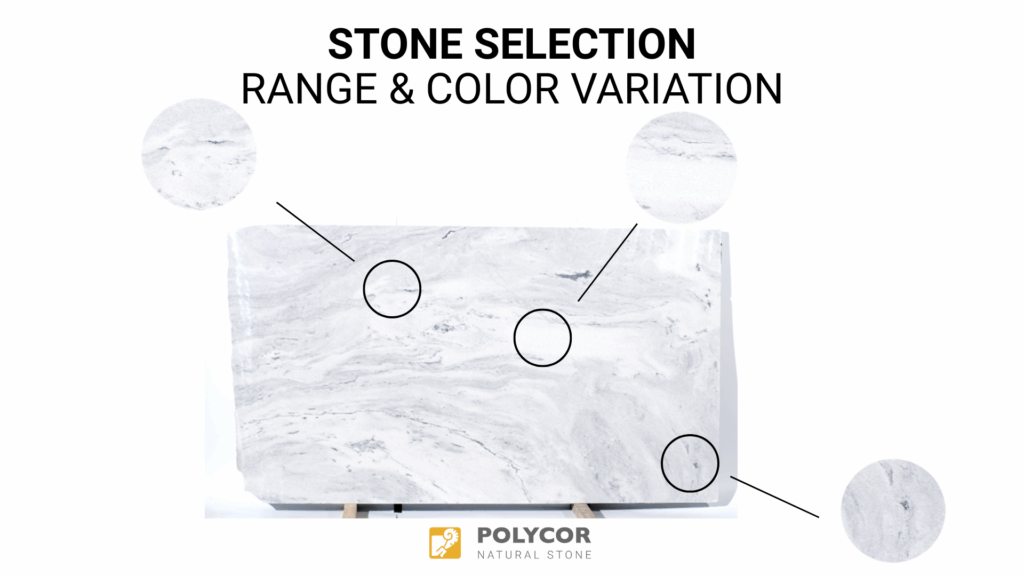
Effective sampling strategies involve distinguishing between aesthetic features such as background color and veining, and physical characteristics like mineral inclusions or micro-fissures. As project specs develop, it’s recommended to continue sampling the stone and to share those samples with clients, building owners and other stakeholders. This ongoing process ensures that design expectations align with the material’s natural characteristics and helps prevent surprises during installation.
Understanding the difference between a promotional sample and a true range approval sample is fundamental to successful stone specification. Range approval samples should reflect light, medium, and heavy variation within the material, giving specifiers and clients a realistic preview of the installed result. This approach is contingent on project size and available blocks, making early communication with the quarry critical for setting accurate expectations – something that most distributors and commercial wholesalers cannot effectively provide.
What Are Paver Range Sheets and How Do They Work?
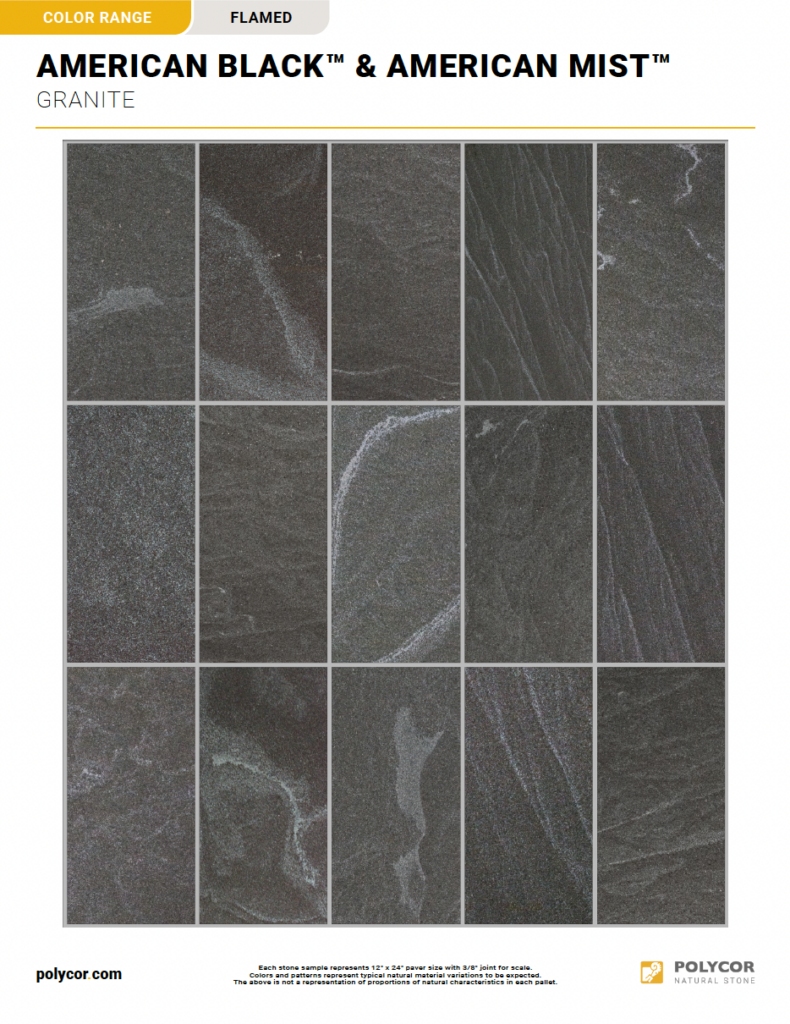
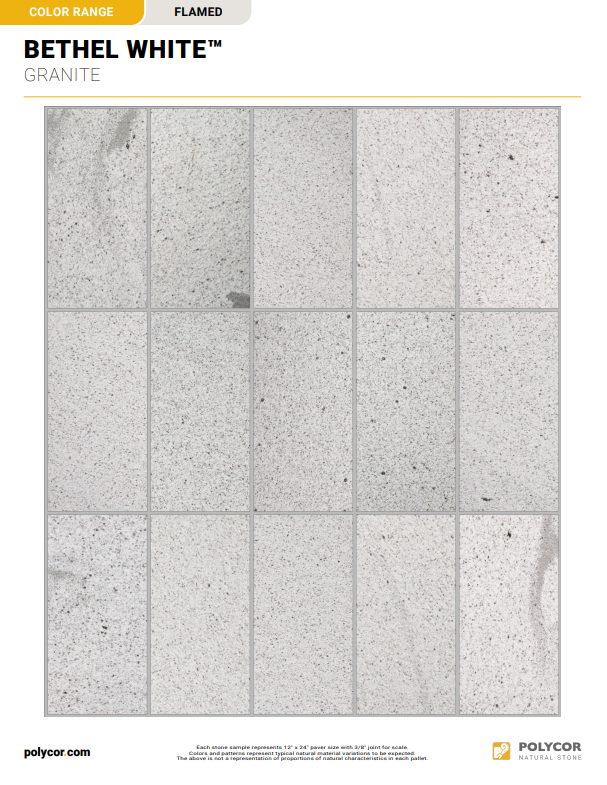
To give specifiers better visibility, Polycor has developed high-resolution scan paver range sheets, available in the Resources section. These valuable documents pair visual examples with technical data to make range acceptance tangible and easier to specify.
The sheets include:
- Visual references with clear photographic documentation of light, medium, and heavy variation
- Cost clarity showing how range choices directly impact project budgets
- Technical specifications for granite pavers (with limestone applications), including dimensional tolerances, finish options, and performance standards
For architects and landscape designers, the sheets serve as a bridge between design intent and project economics. They transform abstract discussions about “range” into clear visual and technical references that can be shared with clients, contractors, and owners.
How to Balance Design Intent with Budget When Specifying Stone Range
Every paving project starts with a vision, but success depends on reconciling that vision with budgets and timelines. Range acceptance is central to this balance.
A thoughtful specification strategy considers square footage requirements, budget parameters, installation sequencing, and material availability. For example, in a multi-phase project, understanding quarry block sizes and production timelines ensures consistency across phases. Selecting finishes that are appropriate to the environment further aligns long-term performance with the design intent.
Projects working within tight budgets can benefit by accepting broader ranges, prioritizing overall harmony rather than piece-to-piece uniformity. Conversely, premium projects may justify tighter ranges, provided all stakeholders understand the higher costs and longer lead times. For very large developments, range can even be negotiated strategically, striking a middle ground that optimizes cost without sacrificing design cohesion.
Does Natural Stone Variation Affect Installation and Long-Term Performance?
Accepting variation is not only an economic decision; it also enhances project performance. Contractors install more efficiently when they can work with a wider pool of material and spend less time sorting. Timelines are shorter because there is no waiting for narrowly defined stone types to arrive from the quarry.
Over the long term, variation contributes to the durability and beauty of a product. Stones weather gracefully, with natural differences blending wear into the overall installation. Highly uniform surfaces, by contrast, often make scratches or stains more conspicuous. In landscape applications, variation integrates seamlessly with surrounding materials, creating a design that feels authentic rather than manufactured.
How Should Architects Use Paver Range Sheets in the Specification Process?
Polycor’s paver range sheets are most effective when they are part of the process from the very beginning. During design development, reviewing them ensures specifiers set realistic expectations. Sharing them with clients aligns design vision with budget implications. In construction documents, citing the exact range category helps prevent misunderstandings, while including range imagery in approvals keeps everyone on the same page.
During construction administration, ongoing sampling and communication with suppliers and contractors help make sure that range acceptance is properly implemented. Documenting these decisions also proves valuable in future phases or related projects..
What Digital Specification Tools Does Polycor Offer for Natural Stone Projects?
The range sheets are part of Polycor’s broader digital resources designed to support specification professionals. By combining real-time visual documentation with technical expertise, these tools help specifiers plan accurately, forecast budgets confidently, and guide contractors effectively.
They also strengthen client communication: instead of abstract discussions, specifiers can show visual examples of variation, explain cost implications, and set expectations for how the finished project will look and perform.
When developing 3-part specifications for granite pavers, ASTM C97, C99, and C170 provide the technical backbone of Part 2: Products. These values establish minimum performance criteria that bidders must meet, prevent substitution with materials of lesser durability, provide measurable assurances for project stakeholders, and support sustainable, long-term outcomes by ensuring materials can handle decades of use.
Embracing the Beauty of Natural Stone
Understanding stone range turns variation into an advantage rather than a challenge. By using Polycor’s paver range sheets, specifiers can balance design goals with project economics, prevent costly surprises, and celebrate the authenticity that only natural stone provides.
The beauty of natural stone lies in the subtle differences that have been shaped over geological time. With the right tools, those variations can be specified with confidence, creating projects that are distinctive, durable, and true to the material’s origin.
Explore Polycor’s full library of paver range sheets and specification resources at www.polycor.com/resources.
Specifier Checklist: Getting the Most from Range Sheets
- Establish communication protocols with contractors for smooth installation
- Align range acceptance with budget goals early
- Base design decisions on current quarry samples
- Select finishes appropriate for application and performance needs
- Reference range sheets directly in documentation and approvals